Walk into a good store and a specific thing happens. Someone greets you. Asks what brings you in. Listens to the actual answer, not the version filtered through a dropdown. Walks you toward the right rack instead of pointing. Pulls something off the shelf and hands it to you. Answers the small question you didn't know you had. Holds three items in their arm while you decide. Walks you to the register and rings you up.
That sequence — greet, discover, guide, hand-hold, close — has been the conversion engine of physical retail for a century. It isn't a feature of the store. It's the whole product. The merchandise is half the reason people come in. The rep is the other half.
Online lost all of it.
Self-Service Was a Stopgap
Ecommerce spent two decades trying to replace the in-store rep with infrastructure. Search bars. Faceted filters. Recommendation carousels. "People who bought this also bought." Personalized homepages. Abandoned-cart drip emails. Live chat widgets staffed by humans who join the conversation half an hour later, if at all.
Every one of these is the absence of a rep, productized. Filters are what you build when you can't ask the customer what they want. Recommendation widgets are what you build when you can't read the room. Cart-abandonment emails are what you build when you couldn't close the sale and couldn't even ask why. None of these tools are bad. They're the best self-service has been able to do. But each one exists because the customer is alone in the store with the lights on and nobody behind the counter.
Then chatbots arrived and reinforced the gap instead of closing it. "Hi! How can I help you?" is what you say when you can't actually help. A scripted bot that can't pull a product off the shelf, can't see what the customer is looking at, can't react to a tone shift, and can't follow up after the customer leaves the page is not a rep. It's a hold queue with a friendlier wrapper.
Video agents are the first thing that changes the shape of the conversation.
What Changes When There's a Rep Again
The shift starts with social dynamics that text widgets can't trigger. A face on screen, a voice, a name. Customers behave differently. They ask questions they wouldn't type. They linger instead of bouncing. They let themselves be guided, because someone is offering to guide them. The mode flips from search-and-evaluate to ask-and-receive. That's the mode that converts.
Then there's continuity through the whole journey. A text chat fragments naturally — greeting, question, answer, you close the tab, you come back later, the thread starts over. A rep-style conversation stays open. The agent greets you, surfaces what's relevant, shows you the product, hears your reaction, pivots, walks you to checkout — all in one unbroken arc, the way it happens in a store. The agent isn't a feature on the page. It's the spine of the visit.
And finally, the agent can do the rep's job. Not in the abstract. Specifically: hear the open-ended question the customer doesn't know how to type. Recommend with reasoning, not keyword matches. Show real products from the catalog inside the conversation. React to something the customer is holding up or pointing at on camera. Take an action on the customer's behalf — email a summary, hold a cart, book a follow-up. The conversation has hands.
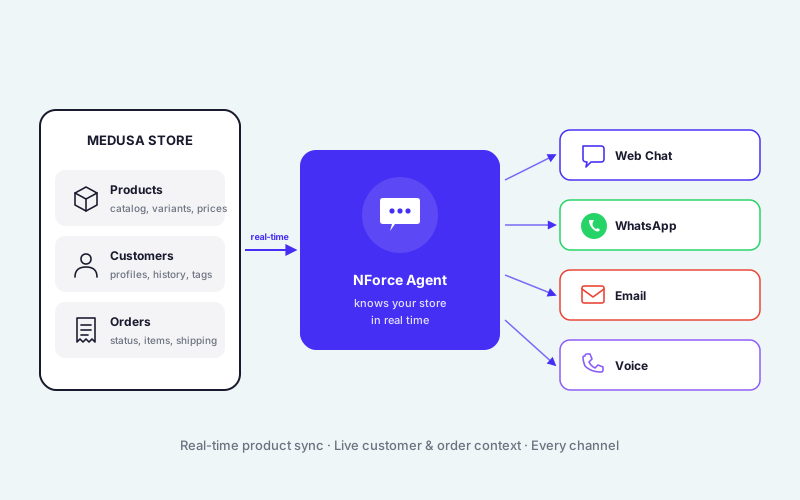
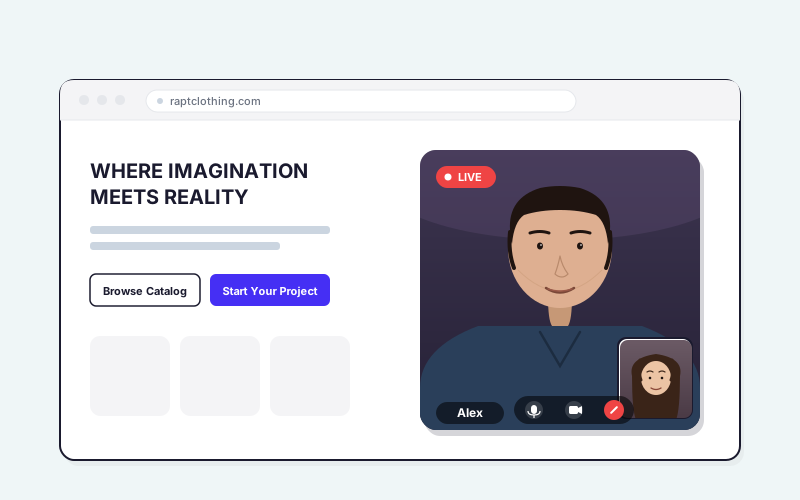
None of this is sci-fi. The technology to do all of it shipped this year, and we recently rolled it into the NForce chat widget. Agents can now be configured as multi-modal, presenting as a video avatar (we use Tavus replicas under the hood), with the option to perceive the customer via webcam or screen share when the conversation calls for it. Everything else is the same agent stack — same playbooks, same knowledge, same tools, same monitoring.
The Rapt Demo
We wired this up on Rapt Clothing's storefront — a custom apparel and merch brand we work with — and recorded a four-minute version end to end. Watch first if you want the shape of it. Breakdown is below.
The conversation moves through every beat of the in-store sequence.
Greeting and discovery. Alex opens with a name and an offer to help. The customer answers honestly: "I'm looking for some accessories I could brand with our logo. We're going to an event next month and we're exhibiting, so it'd be nice to have something to give away." That's not a search query. No filter set captures "we're exhibiting and need giveaways." It's a real-world question, asked the way customers actually ask things, and the agent treats it as one.
Reasoning-led recommendation. Alex doesn't return a list of SKUs. It returns three categories with reasons: drinkware (always appreciated, keeps the brand visible), headwear (practical, eye-catching), power banks (people actually carry them daily). This is what a good in-store rep does. It's also what a recommendation carousel cannot do — a widget can rank products, but it can't tell you why each one fits the scenario you described.
Show, not link. When the customer says "I really like the ultra-thin power bank," Alex pulls it up inside the conversation — image, color options, dual-USB detail, ready for branding. The conversation has the catalog inside it. The customer doesn't have to navigate away to look at a product and then come back to ask about it. The product is right there.
The pivot. The customer changes direction. "Maybe we can put a pin on this for now. I'd also like to show you a hat I have and see what you think." A text widget gets stuck here — the customer means to physically show the hat, and without vision the agent has to ask them to describe it, find a similar image to reference, or push them back to the catalog. Instead, the customer holds the hat up to the webcam. Alex sees it — "a black cap with a pink N8N logo on it, clean simple design with the logo on the front" — confirms understanding, and asks the right follow-up: "What do you like about this cap? The style, the color scheme, the logo placement?" The customer says color. Alex now knows what they're actually after, and matches two style options from the catalog.
Close and handoff. The customer wraps the visit the way customers actually wrap visits: "I'm going to run these by my marketing manager. Maybe you can email me this stuff?" Alex takes the email address, sends a summary with the products discussed, closes the conversation warmly. The visit ends with the marketing manager getting a clean follow-up email tied to a real conversation. No abandoned tab. No "come back when you've decided." No cold drip sequence starting from scratch.
This isn't a chatbot interaction. It's a sales visit. It happens to be on a webpage.
What This Means for the Practice
For the agencies and consultants building on top of agentic platforms, this is a new service tier worth understanding. The merchants who win the next decade of ecommerce will be the ones whose storefronts feel staffed. That's not a brand exercise — it's a conversion difference. A typical apparel or accessories site converts somewhere around 2-3% of sessions. A site where every high-intent visitor gets the in-store experience converts higher, on better average order value, with a follow-up infrastructure attached. Those numbers move budget.
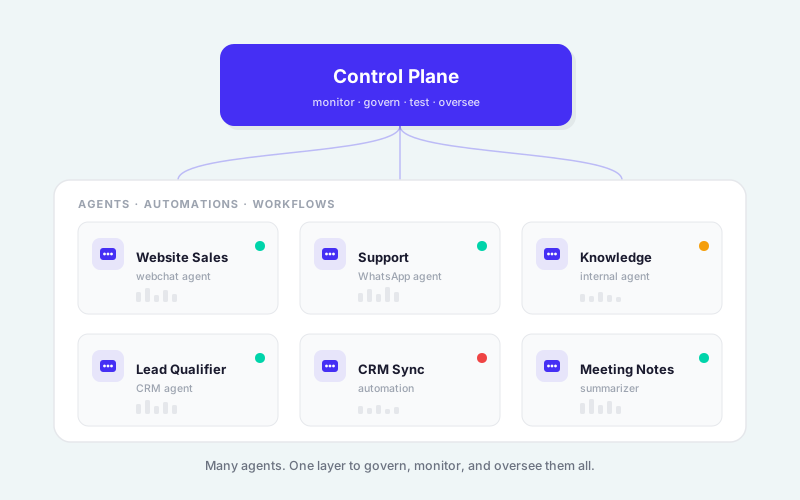
The work itself is what an agentic systems engagement looks like. Discovery to understand the catalog and the conversation patterns. Behavioral design so the rep matches the brand's voice and handles edge cases — out-of-stock items, budget concerns, comparison requests, returning customers. Knowledge architecture so the agent has real-time product context. Testing so the rep doesn't say something that embarrasses the merchant. Monitoring so optimization is continuous. The video layer is one capability on top of all that. The discipline underneath is the practice.
Ecommerce has been waiting twenty years for the rep to come back. The teams that figure out how to bring them online — and run that infrastructure for the merchants who can't — are about to own a category.